

Napoleon an emulator of the Greats
A lover of biographies of the greats
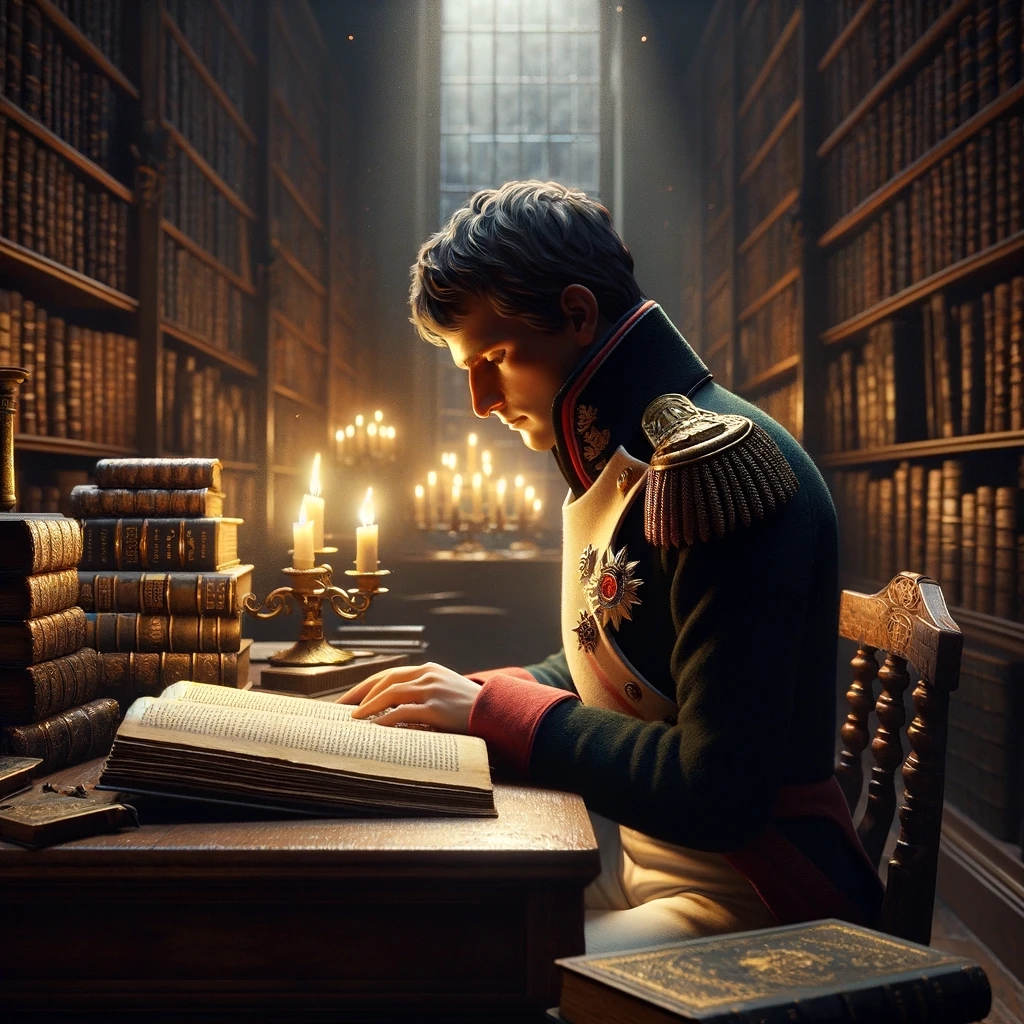
A young Napoleon in an imaginary library – Image created with artificial intelligence
Napoleon was a great reader of novels, historical books, especially those concerning the ancient world, as well as philosophical works. Since childhood, he read a lot, a passion he cultivated even as a cadet at the military academy; sometimes he would skip meals just to buy an extra book. As proof of his love for reading, during the Egyptian campaign he brought with him 125 books including Captain Cook's "Voyages", Montesquieu's "The Spirit of the Laws", Thucydides, Plutarch, Tacitus, and Julius Caesar. He particularly loved ancient history books and compared himself to the great figures of the past, not only that, he also imitated them especially in his political maneuvers. When offered the position of Consul for life, he declared to the Senate: "You believe that I owe another sacrifice to the people. I will do it if the voice of the people orders what your vote now authorizes," simulating reluctantly accepting the position just as Caesar, it was said, had refused the position of king of Rome three times. In Egypt, he also brought the Quran which shows how his media skills led him to empathize with his Muslim Egyptian interlocutors. His desire to imitate the greats led him to attempt to build an empire in the east, with the Egyptian campaign, dreaming of using it as a launching pad to reach India. An idea he never completely abandoned, in fact in 1801 he contemplated invading India starting from the Caspian Sea, in alliance with Tsar Paul I with whom he had excellent relations. The plan involved sending 35,000 French soldiers to Astrakhan where they would join 35,000 Russians and 50,000 Cossacks, then cross the Caspian Sea and head to conquer Kandahar, from where the invasion of India would begin. This plan was never implemented also because Tsar Paul I was assassinated following a conspiracy by Russian aristocrats dissatisfied with the policies of the Armed Neutrality League, which restricted trade with England.
Andrew Roberts, Napoleon the Great, Penguin 2015
2025-12-17
Salvatore Ciccarello