


Věra Čáslavská's podium
The look that became resistance
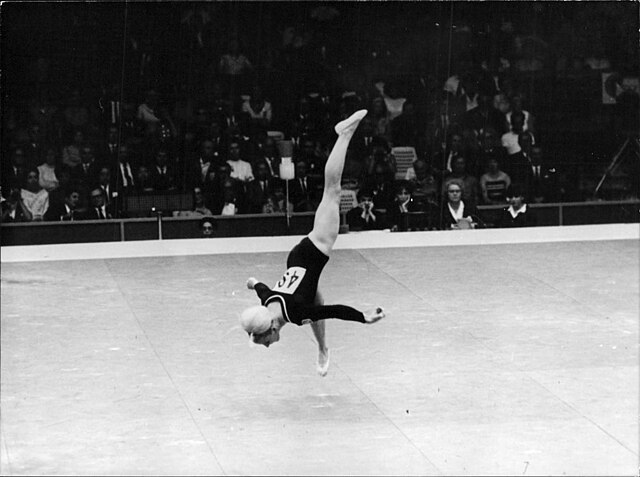
Věra Čáslavská during the floor exercise competition at the Mexico City Olympics, 1968 - Wikimedia Commons
The Olympics often conceal powerful stories, and sometimes a small gesture is enough to resurface issues intertwined with politics, memory, and national identity. At the 1968 Olympic Games in Mexico City, Věra Čáslavská, a Czechoslovakian artistic gymnast, lowered her gaze during the ceremony and performed a gesture destined to go down in history, transcending the boundaries of sport. Čáslavská confirmed her dominance in Mexico City by winning gold and silver in every event, including the floor exercise final. Despite her flawless execution, the jury awarded a gold medal jointly to Věra and Larisa Letik of the Soviet Union.
The sight of the two athletes on the same podium step, their respective flags behind them, was a profound humiliation for Čáslavská. When the Soviet anthem rang out, the Czechoslovakian gymnast looked to the right, refusing to witness that bitter scene. With that simple movement of her face, Věra Čáslavská entered history, becoming a symbol of resistance and social dissent.
It was the events that had struck Czechoslovakia that made that moment so painful: in August 1968, the "Prague Spring," the reformist attempt to introduce greater political and civil liberties than those granted by the Soviet regime, was harshly repressed by Warsaw Pact troops sent from Moscow. Czechoslovakia, already a satellite country, thus returned to the rigid and oppressive control of the USSR, characterised by censorship, constant surveillance, and the repression of any protest.
With that wound still open, just months before the opening of the Games, Věra Čáslavská arrived in Mexico City not only as an athlete, but as a citizen scarred by the violence in her country.
On the Olympic stage, moments of sport and history intertwined: a Czechoslovakian gymnast representing an oppressed country, forced to share first place with a gymnast representing the oppressor, decided—while remaining silent—to declare her opposition to that kind of power clearly. On that podium in Mexico City, Věra Čáslavská not only looked to the right during the Soviet anthem, but also communicated her open rejection of an oppressive regime that had suffocated her country's freedom. She gave voice to an entire wounded and humiliated nation, and has become, to this day, one of the most powerful symbols of twentieth-century civil history.
Riccardo Gazzaniga, Abbiamo toccato le stelle. Storie di campioni che hanno cambiato il mondo, Rizzoli, 2018
2026-02-12
Paola Manunta