


The establishment of the Moscow Patriarchate
A significant development within the Orthodox Church of the 16th century
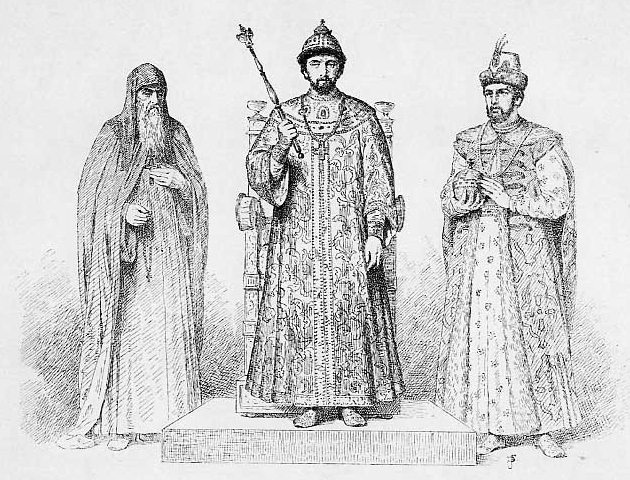
Patriarch Iov, Tsar Fyodor I and the mighty Boris Godunov, the architects of the establishment of the Moscow Patriarchate - Wikimedia Commons

In 1448, the Metropolis of Moscow unilaterally declared its autocephaly, meaning legal independence from the Ecumenical Patriarchate of Constantinople, which did not recognize the decision. As a result, the Russian capital became de facto autonomous but not de jure. This nominal dependency became unacceptable to the increasingly powerful tsars of the 16th century, who were ever more conscious of their status. Moscow’s rise as an imperial city demanded that the ecclesiastical dignity of its principality not remain limited to the rank of a metropolis but be elevated to the status of a Patriarchate, equal to that of Constantinople. However, only the primate of the latter had the authority to grant such recognition.
By the late 16th century, Moscow decided to take decisive action. In 1588, Tsar Fyodor I (1584–1598) and his influential advisor Boris Godunov took advantage of the visit of Patriarch Jeremias II Tranos, who was seeking financial aid for his struggle against the Ottoman Turks, to press for recognition of the Russian Patriarchate. Jeremias was “detained” in the Kremlin for a year in a form of luxurious captivity until he was ultimately compelled to yield to the tsar’s ambitions.
In January 1589, a council convened in the Kremlin in the presence of the tsar and Jeremias officially granted patriarchal dignity to the Metropolitan of Moscow, Job (Iov), and formalized the establishment of the Moscow Patriarchate through the Charter of the Moscow Patriarchate, a document that modern historians largely consider a forgery.
Upon returning to Constantinople, Jeremias convened two local councils in 1590 and 1593, which led to the official recognition of the Moscow Patriarchate. However, Job was granted only the fifth place in the hierarchy of patriarchs—Moscow had aspired to the third, after Constantinople and Alexandria. Additionally, he received the title of Patriarch of Moscow and All Russia and the Northern Lands, which denied him jurisdiction over all the territories that had once belonged to ancient Rus’. Some of these lands, over which Constantinople sought to retain authority, were at that time under the control of the Polish-Lithuanian Commonwealth.
Giovanni Codevilla, Storia della Russia e dei Paesi limitrofi: Chiesa e Impero, vol. I: Il medioevo russo, secoli X-XVII, Vol. I, Jaca Book, Milan, 2016.
2025-12-15
Salvatore Ciccarello