


Locust: the gall that lays golden eggs
A Witch at Nero's Court
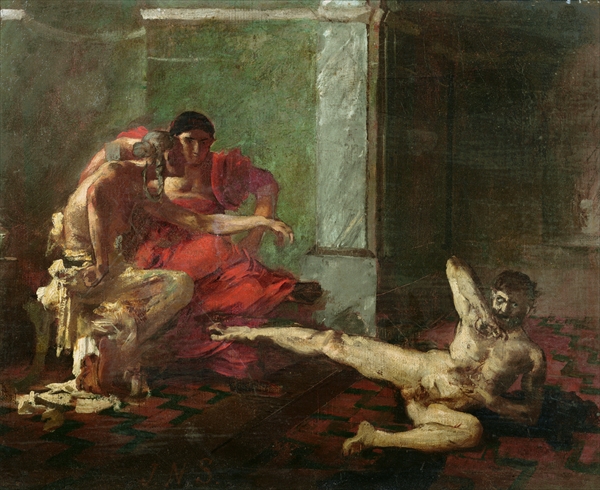
Joseph-Noël Sylvestre, Locusta Testing Poison on a Slave, oil on canvas, 1870-1880 - Wikimedia Commons
During the reign of Emperor Claudius in the Roman Empire, a young girl arrives in Rome from Gaul as a slave, later known by the nickname Locusta. Raised in the rural regions beyond the Alps, she learns to mix and understand all types of herbs to create medicines, potions, elixirs... and poisons. Imprisoned due to laws against witches, sorcerers, and fortune-tellers, Locusta, once freed, opens her shop on the Aventine Hill, becoming the trusted merchant of the capital's matrons. She soon attracts the attention of Agrippina. After witnessing the witch’s skill in preparing poisons—studying the victim's habits, body, and dietary routines—Agrippina decides to use her for her own purposes: to eliminate the opposition to her son Nero by killing Emperor Claudius, their main obstacle. The emperor is killed with his favorite food, mushrooms, poisoned by Locusta with a concoction that first clouds the mind and then slowly, but not too slowly, devours the body from within. With Claudius dead, Nero becomes emperor, as Agrippina had planned, and Locusta is showered with honors. Shortly after, however, due to a new edict against witches, Locusta is imprisoned again. This time, freedom is offered by Nero in exchange for eliminating the last obstacle to his power: his thirteen-year-old stepbrother Britannicus. Nero organizes a banquet with the entire court and serves boiling wine to Britannicus. The young boy then asks for water to cool it, but as soon as he takes a sip, he dies quickly in convulsions. With the last rival eliminated, Nero rules until 68 AD, and Locusta becomes the most important figure at court, committing murders on demand without interference. Her glory ends on January 9, 69 AD, shortly after Nero’s downfall. Condemned to death by the new Emperor Galba, legend has it that she was dragged in chains through Rome, raped by a giraffe, and thrown to wild beasts in the circus. She was a "serial" poisoner, but on commission, and according to testimonies, she killed over four hundred people. In short, a name that guaranteed death.
- A., A., Pedatella, Le donne più malvagie della storia d'Italia, Newton Compton Editors, Rome, 2016. (Newton Compton Editori)
- Giovenale, Satire, tr. it. edited by U., Dotti, Feltrinelli, Milan, 2013. (Feltrinelli)
Scarpato Deborah - Master's student Ca' Foscari University - Venice
2026-01-08
Salvatore Ciccarello