


A medieval rentier state
Rus’, its heirs and the dependence on fur exports
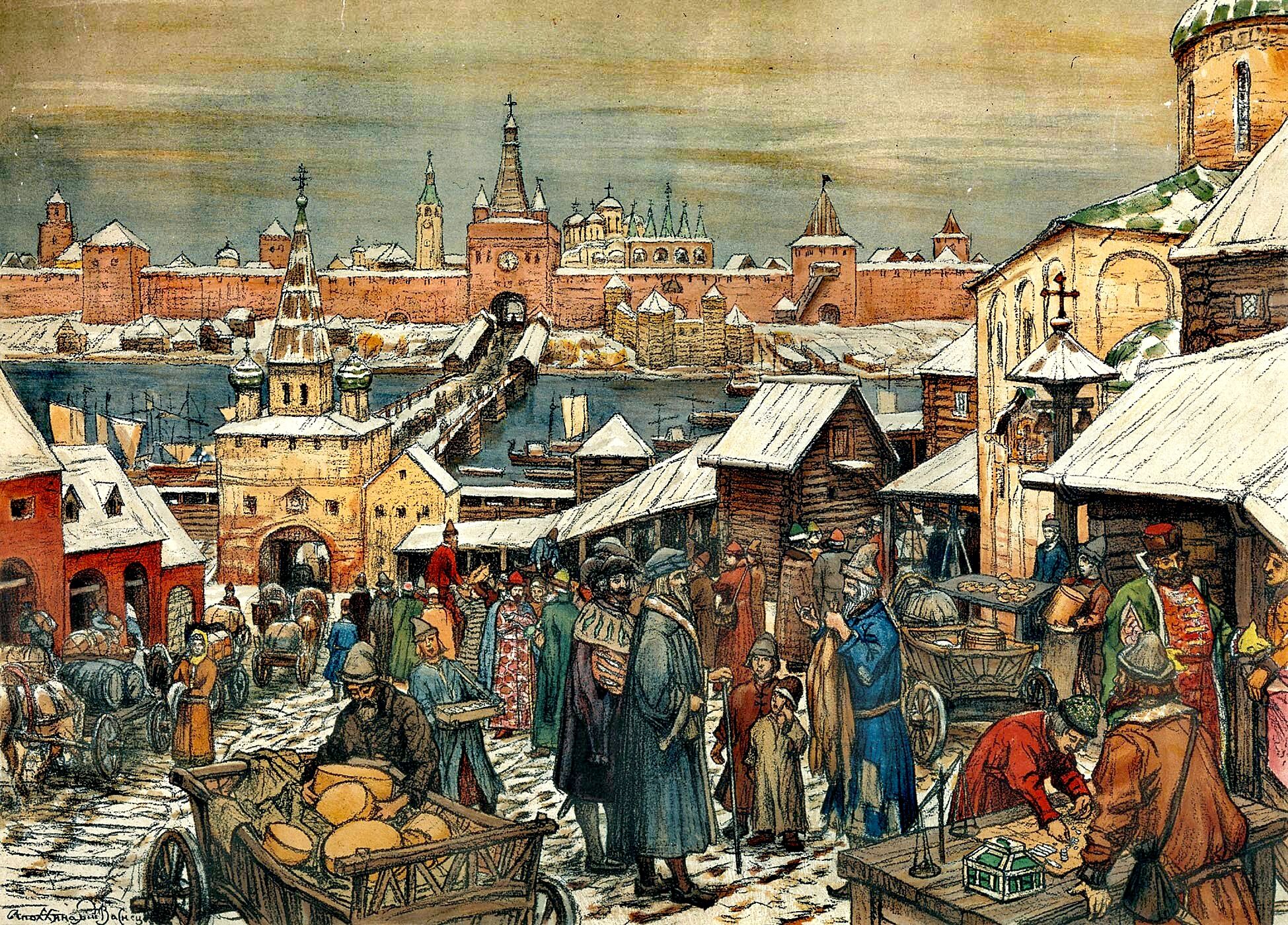
The Novgorod Market (painting by Apollinarij Vasnetsov, 1908-09 – Wikimedia Commons)

Russia's dependence on the export of natural resources has been a constant throughout its history. While today this dynamic revolves around gas and oil, in the past—spanning at least from the 11th to the 17th century—it was based on the trade of animal furs.
The earliest recorded evidence of this phenomenon appears in the Primary Chronicle and dates back to the year 1096. This medieval source describes trade relations between the Rus’ and the Ugro-Finnic natives of the Yugra region, in which tools such as knives and axes were exchanged for furs. The city of Novgorod was the first to center much of its economy around this system of barter and coercion, expanding it as far as the Ural Mountains and forcing Arctic populations into a commercial framework that led to the extermination of both animals and humans. This system began to collapse in the mid-15th century due to the depletion of fur-bearing animals, a development that contributed to the decline of Novgorod’s power and its eventual conquest by Moscow. To grasp the scale of this trade, consider the import figures of Novgorod’s main client, England: in 1381 alone, London purchased 350,000 squirrel pelts, while in the 15th century, a single garment for King Henry IV required 12,000 squirrel pelts and 80 ermine skins.
During the 16th and 17th centuries, Moscow—having risen as the dominant power in the region—continued to rely on fur exports. However, it extended the area of fur procurement much further east, beyond the Urals, leading to Russia’s conquest of Siberia, which began in 1581. The previously established economic system was expanded into these new territories, resulting in the mass slaughter of even greater numbers of animals and, in many cases, outright genocides of indigenous populations. Another depletion of commercially viable resources triggered yet another economic crisis in Russia. By the 18th century, aided by territorial expansion into the fertile lands of Ukraine and the Caucasus, the Russian state shifted its focus toward agricultural development, making grain and cereal products the backbone of its exports.
Alexander Etkind, Internal Colonization. Russia’s Imperial Experience, Cambridge-Malden, Polity, 2011.
AA.VV. Racconto dei tempi passati. Cronaca russa del XII secolo, edited by I.P. Sbriziolo, Italian translation, Turin, Einaudi, 1971.
2026-01-21
Salvatore Ciccarello