

The religious conversion of Vladimir the Great
"Drinking is the joy of the Rus. We could not exist without such pleasure."
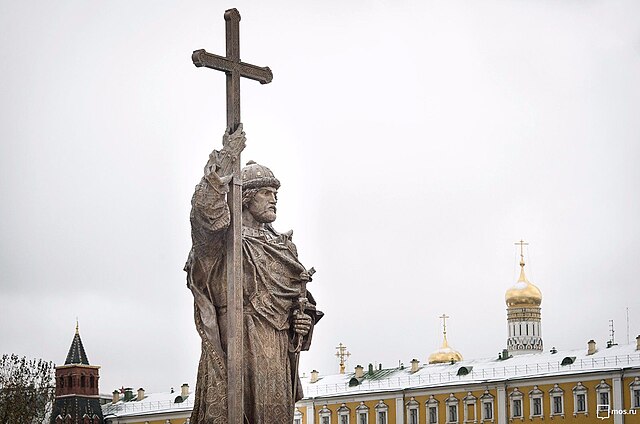
Monument dedicated to Vladimir the Great - Wikicommons
Vladimir the Great (980-1015) earned his epithet through the actions he undertook after becoming ruler of the Rus': he eliminated local princes who could become powerful political rivals, personally appointed lieutenants responsible for tax collection (poliudie), seized new fortresses, and worked to make the borders with the steppe less dangerous. However, his greatest achievement was promoting Christianity in his principality and converting his people.
The account of Vladimir's religious conversion is primarily based on the writings of Nestor.
According to this source, during his reign, Vladimir received visits from representatives of various religions. The first were Muslim envoys from the Bulgars, whom the prince rejected because their faith forbade alcohol consumption. Nestor records Vladimir’s response: "Drinking is the joy of the Rus. We cannot live without such pleasure."
The second group consisted of Latin Christian envoys from Germany, who were dismissed without explanation. A delegation of Jewish ambassadors arrived next but was also turned away because Jews had previously been expelled from his lands. Finally, a representative of the Greek Orthodox faith came to his court.
After listening to all the religious delegations, Vladimir was unsure which faith to adopt. His advisors recommended sending emissaries to observe the religious practices firsthand. These envoys were deeply impressed by the grandeur of the Hagia Sophia in Constantinople and the Greek Orthodox liturgy.
Despite this, Vladimir delayed his baptism. The following year, he decided to attack Cherson, and the subsequent peace negotiations with Constantinople led him to choose baptism as part of an agreement to marry Princess Anna.
Religious tradition also adds that during the siege of Cherson, Vladimir suffered an eye disease that led to blindness. According to legend, he regained his sight only after accepting baptism and upon Anna’s arrival in the Crimean city.
Leciejwicz L., La nuova forma del mondo. La nascita della civiltà europea medievale, Il Mulino, Bologna, 2004
Site: Poppe A., The Political Background to the Baptism of Rus': Byzantine-Russian Relations between 986-89, in Dumbarton Oaks Papers, vol. 30, Cambridge, 1975, Jstor.org (accessed February 2025)
Wilken R., I primi mille anni. Storia globale del cristianesimo, Einaudi publisher, Turin, 2013
2026-02-06
Salvatore Ciccarello