


Racialised Capitalism
How the US hid racial segregation behind the mask of freedom
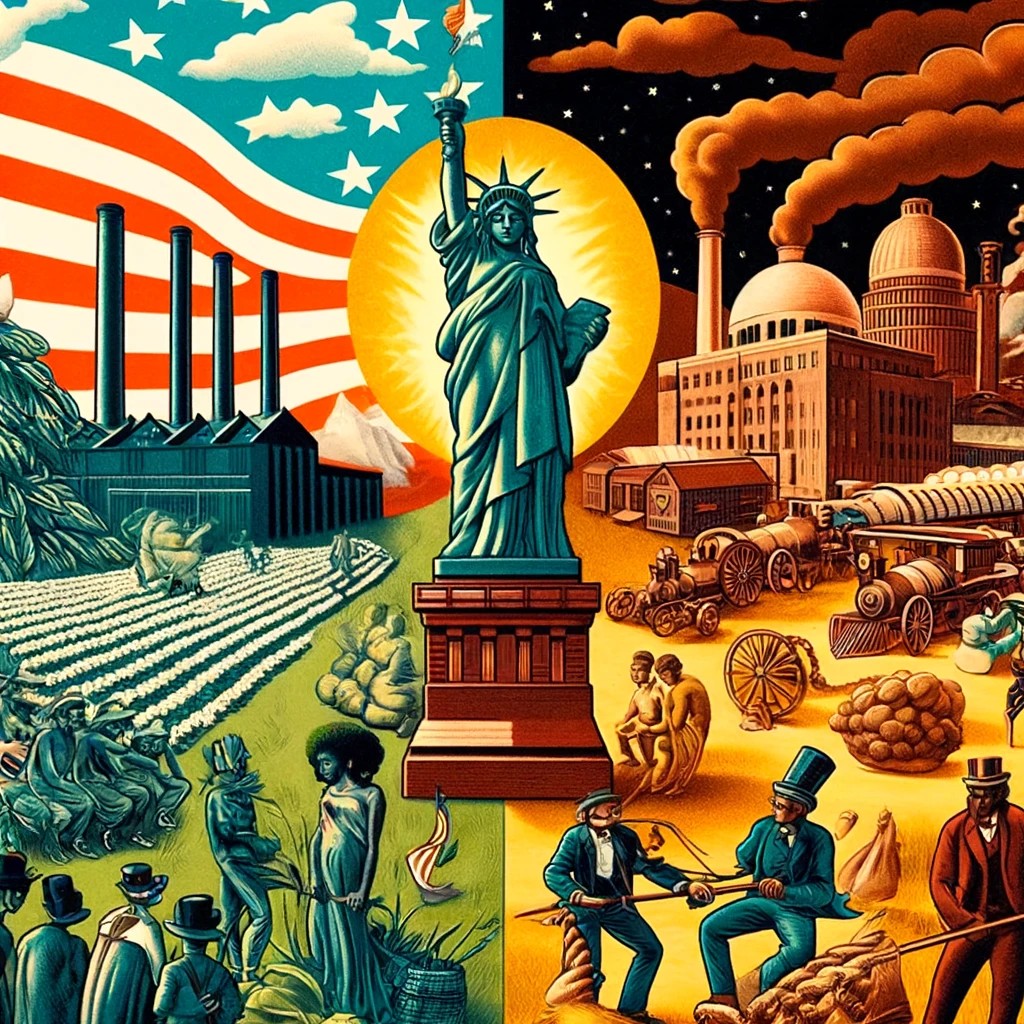
The dark side of American prosperity: racial exploitation and racialised capitalism behind the myth of freedom - Image generated with AI
Throughout its history, the United States has established itself as a formidable economic power, fuelled by industry and the capitalist system. However, the roots of American economic prosperity are much more controversial than the more traditional history books have claimed for many years. Since the 1980s and 1990s, academic studies, termed postcolonial and postmodernist, have initiated a critical revision of American history, incorporating new perspectives and focusing in particular on the histories of the parts of the population that suffered most from the adoption of a racialised capitalist free-market system that crushed and exploited minorities to promote the wealth of the white population alone.
Works by authors such as Tiya Miles or Roxanne Dunbar Ortiz have helped to remind us that a significant part of US history and economic heritage was built on the exploitation of African American slave labour and the expropriation of indigenous lands in the West. The repression and exploitation of Indians and African Americans, since the origins of the American nation, have unfortunately characterised the origins of the white population's accumulation of wealth.
The contradiction of the idea of American freedom emerges even more clearly when one considers the condition experienced by the African American population even after the Unionist victory in the Civil War at the end of the 19th century. Lincoln's liberation of the slaves did not lead to an effective integration of blacks with white American citizens. Shortly after their liberation, with the adoption of the Jim Crow Laws, the black population was again subjected to an economic and political segregation that separated them from whites, even in means of transport. Only the reforms implemented by President Kennedy in the 1960s brought about a radical change.
The picture that emerges is that of an alternative history of the United States in which the image of freedom and individualism gives way to that of exploitation and racism intrinsic to the American free market system.
Tiya Miles. All That She Carried: The Journey of Ashley’s Sack, a Black Family Keepsake. New York: Penguin Random House, 2021.
Roxanne Dunbar-Ortiz. An Indigenous Peoples’ History of the United States. Boston, MA: Beacon Press, 2015.
Toniatti Francesco
Master of Arts in International Relations - University of Leiden
Master of Arts in History and Oriental Studies - University of Bologna
Former History Teacher - International European School of Warsaw
2025-11-05
Francesco Toniatti