


The Saint of Kulikovo
Saint Sergius of Radonezh and the revival of Monasticism in Rus'
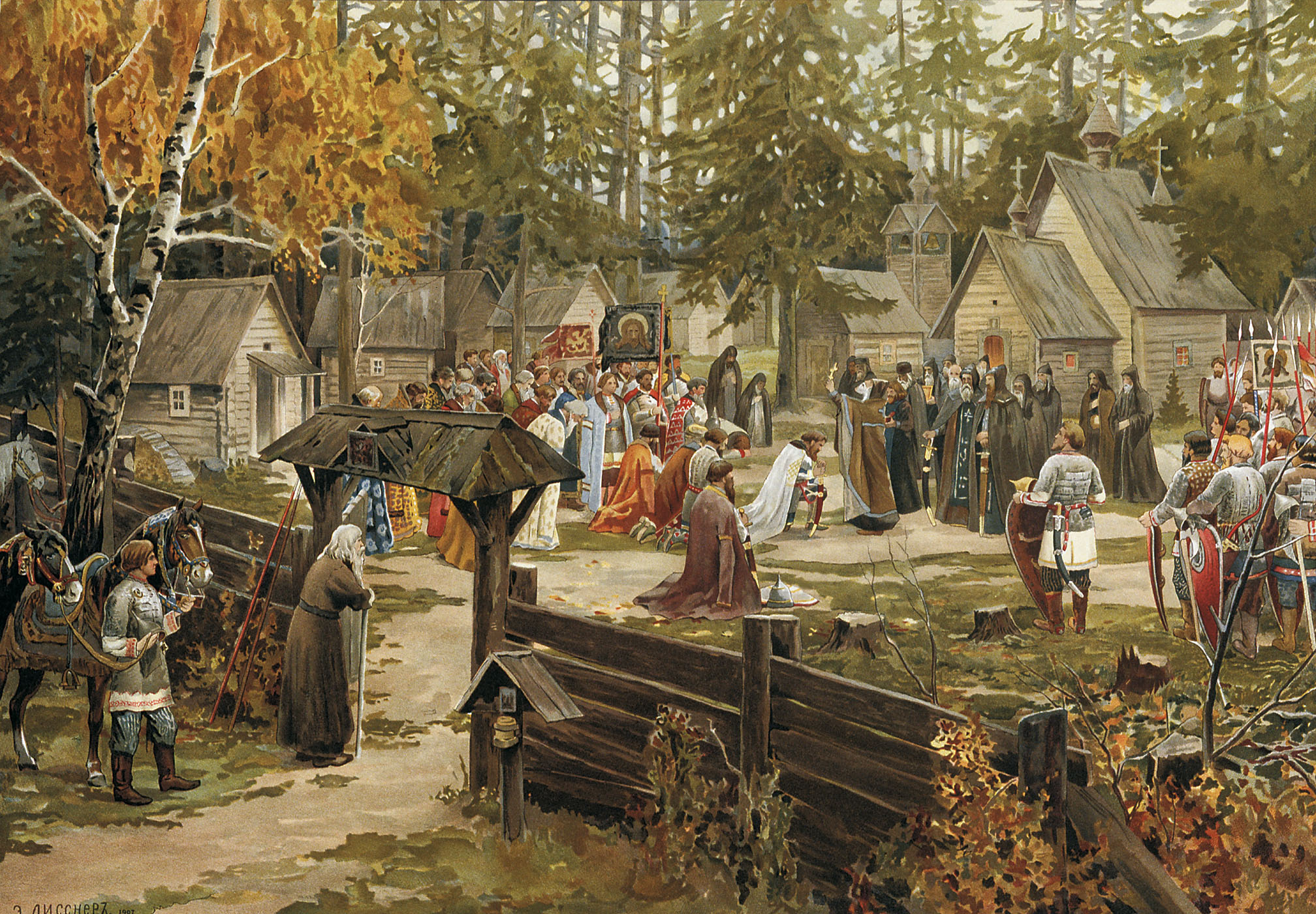
Sergius of Radonezh blesses Grand Prince of Moscow Dmitry Donskoy before the Battle of Kulikovo at the Trinity Lavra of St. Sergius in present-day Sergiev Posad (watercolor by Ernst Lissner, 1907) – Wikimedia Commons)
The emergence of monasticism among the Rus’ dates back to the first half of the 11th century, following their conversion to Christianity. Initially (11th-13th centuries), monasticism developed in urban areas and favored cenobitic life. Between the 14th-15th centuries, during the time of St. Sergius, the Athonite idiorrhythmic ideal prevailed. As the number of the saint’s disciples grew, there was a decisive return to cenobitic life, marked by the introduction of Rules or Statutes (Ustavy) in monasteries.
When the story of Sergius of Radonezh (1322-1392) began, Russian monasticism was experiencing a crisis due to the fragmentation of Rus’ and the Mongol domination. Coming from a once-noble boyar family and experiencing mystical visions from a young age, Sergius initially promoted eremitic life through the pustynniki movement—hermits who settled in remote areas (pustynja meaning "desert"), inspired by the earliest monks. Unlike the deserts of the Middle East, Russia had vast steppes and forests. Sergius himself settled near a small church dedicated to the Holy Trinity in Radonezh, north of Moscow. Later, as followers began to gather, he shifted toward cenobitic life, founding the original nucleus of what would become the Trinity Monastery of St. Sergius.
By 1380, Sergius had become a major religious figure. He blessed the Muscovite troops of Dmitry Donskoy before their departure for the Battle of Kulikovo, a victory marking Moscow’s triumph over the Mongols and the beginning of the end of the "Tatar yoke." This act was seen as the perfect fusion of princely political ideals and religious ideals, inspiring the formation of a national consciousness. This growing sense of unity between state and people laid the foundation for the Russian state and the eventual revolt against Tatar rule.
Sergius’ influence sparked a moral revival and led to the establishment of many monasteries. A striking example of this transformation is the comparison between the 1st century of Mongol rule (1240-1340), during which only about 30 new monasteries were founded, and the following century (1340-1440), which saw the establishment of over 150 new monastic communities.
Maria Bylkhova, Il monastero delle Grotte di Kiev come fondamento spirituale della formazione del monachesimo russo, in Gabriele De Rosa, Francesca Lomastro (eds.), L’età di Kiev e la sua eredità nell’incontro con l’Occidente: atti del convegno, Vicenza, 11-13 aprile 2002, Rome, Viella, 2003, pp. 79-90.
Giovanni Codevilla, Storia della Russia e dei Paesi limitrofi: Chiesa e Impero, vol. I: Il medioevo russo, secoli X-XVII, Milan, Jaca Book, 2016.
2025-11-13
Salvatore Ciccarello