


The Invention of Marsala
John Woodhouse's Intuition
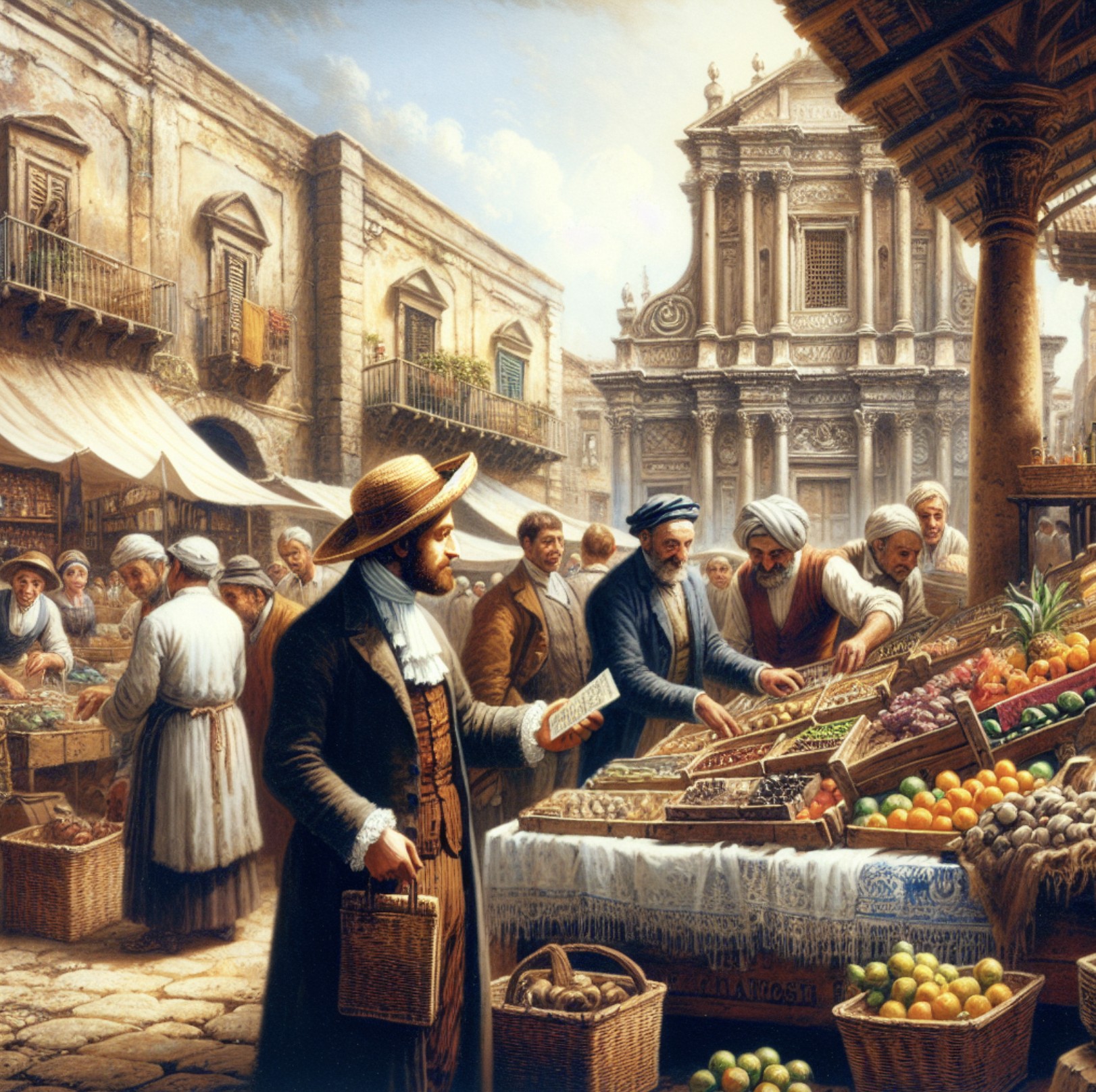
How AI imagines an English merchant trading in Sicily.
The internationally renowned Sicilian wine Marsala was invented by an Englishman. Professor Alberto Grandi's research revealed that an English merchant, a certain John Woodhouse, originally from Liverpool, arrived in Sicily in 1770. In 1773, Woodhouse sent a cargo of slightly sophisticated wines to his homeland: in fact, Woodhouse had added 4.5 litres of alcohol per 415 litres of wine stored in the brigantine's barrels, in order to preserve the cargo more effectively. This modification was very successful and won the favour of English customers, who were particularly keen on buying liqueur wines. However, Woodhouse was careful not to specify the name and origin of the wine, so that retailers could pass it off as the well-known and much-appreciated Madeira; as Grandi writes, "Marsala began its more than century-long history with a counterfeit". It was not until the early 19th century that Marsala changed its name and acquired a primitive form of identity, becoming known in England as "Bronte Madeira". This name derives from the supply of 500 pippe (a pippa was a Sicilian barrel with a capacity of 400 litres) on 19 March 1800 that Admiral Horatio Nelson requested to supply the British fleet in the Mediterranean. Due to the difficulties in supplying the wines traditionally used by the English navy - Porto and Madeira - it was decided to source the Sicilian wine produced by the Woodhouse. The name "Bronte Madeira" derives from the fact that Admiral Nelson had been recently appointed Duke of Bronte; there is no doubt that this connection with the English admiral contributed to the spread and fame of the wine produced by the Woodhouse house. The fine-tuning of Marsala production came with the arrival in Sicily of another English merchant, Benjamin Ingham, in 1812. He purchased an oenological facility (also known as a baglio) near Woodhouse's. Since the final Marsala result was still too variable, Ingham published the so-called "Ingham Decalogue", which aimed to "prevent the taste from varying too much from one year to the next, but also to further reduce production costs and increase profits".
Alberto Grandi, Denominazione di origine inventata, Milan, Mondadori, 2018, pp. 90-98.
2025-10-28
Giacomo Tacconi