


A Contested Carriage
A railway cart at the center of two wars
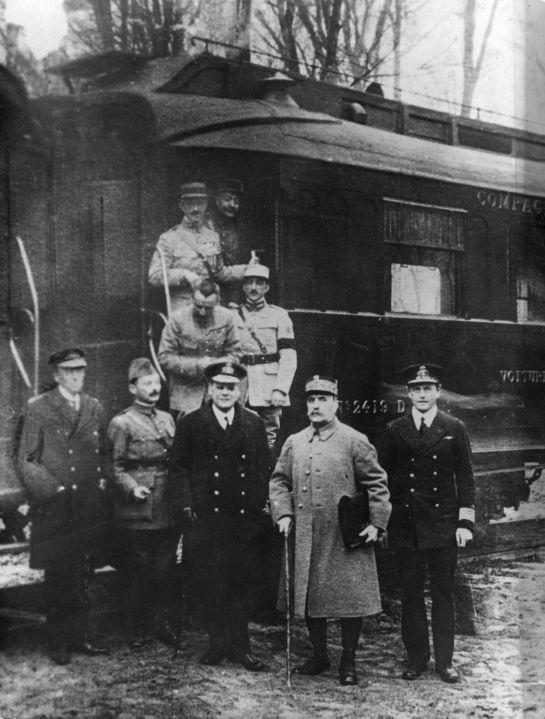
This photograph of the Compiègne railway carriage was taken in the clearing of Rethondes, following the signing of the armistice agreement that brought the First World War to an end. - Wikimedia
In the autumn of 1918, Germany was in the midst of military and political collapse. Following the November Revolution and the abdication of the Kaiser, representatives of the new government requested an armistice from the Allies. Marshal Ferdinand Foch, Supreme Commander of the Allied Forces, chose a secluded location for the signing: a railway carriage belonging to the Compagnie Internationale des Wagons-Lits, requisitioned by the French army and placed in the clearing of Rethondes, in the Forest of Compiègne.
At 5:20 a.m. on 11 November 1918, within that carriage, the armistice that brought the First World War to an end was signed. The terms required the pullback of German troops, the surrender of heavy weapons, and the concession of the fleet. At 11:00 a.m., the guns fell silent, and the world received the news with both relief and disbelief.
After the signing, the carriage, identified as No. 2419D, became a symbol of French pride. Displayed from 1922 at Les Invalides in Paris, it was later returned in 1927 to the dell at Compiègne, where it was restored thanks to the industrialist Arthur Henry Fleming. Around the carriage, a commemorative pavilion was built, which became a site for official visits and ceremonies celebrating the 1918 victory as a triumph of peace and democracy.
However, twenty-two years later, that place of remembrance was transformed into a site of revenge. In June 1940, following France’s loss, Hitler ordered that the same carriage be brought back to the dell at Rethondes for the signing of France’s surrender. On 21 June, he arrived there in person, intent on humiliating his former enemy. The next day, on 22 June 1940, the French envoys signed the armistice with Nazi Germany at precisely the exact spot where Germany had capitulated in 1918.
Immediately afterwards, Hitler had the clearing destroyed and the carriage transported to Berlin as a war trophy. It remained in Germany until 1945, when it was likely destroyed in a fire during the final stages of the conflict.
In 1950, for the opening of the Armistice Museum, an identical carriage was installed in the dell, furnished and decorated to replicate the original. To this day, the plaques bearing the names of the plenipotentiaries from both delegations and the flags of the participating states can be seen.
The Compiègne carriage serves as a powerful symbol of European memory, a witness to two armistices.
It first stood as an emblem of peace and later as an instrument of revenge, a reminder of how the symbols of history can be reinterpreted in opposing ways by those who hold power.
Website: The emblematic carriage of the 1918 and 1940 Armistices, Mèmorial de l’Armistice, consulted November. 2025
Website: How We Made the Peace, Imperial War Museum, consulted November. 2025
Artemisia
2025-11-11
Davide Istess