


On the beautiful blue Danube: a meeting of two worlds
The meeting between a Byzantine emperor and a Rus' prince
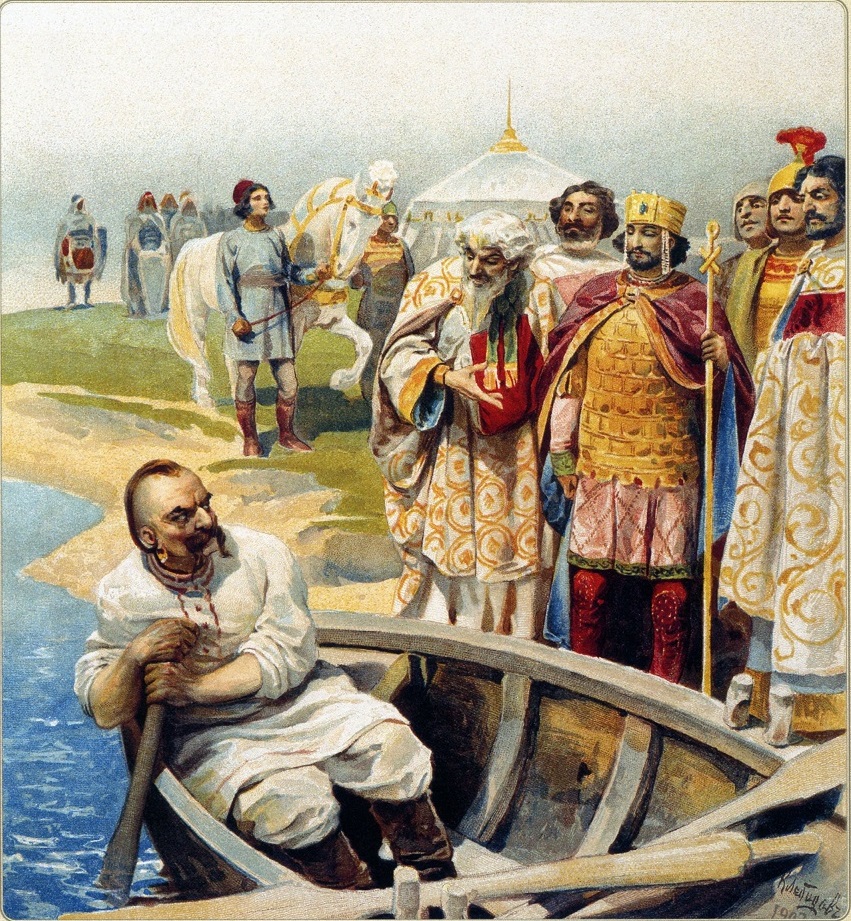
The meeting between Sviatoslav and John Tzimiskes on the banks of the Danube in 971 (lithograph by Klavdij Lebedev, ca. 1880) – Wikimedia Commons).

Though little-known, the conflict between Byzantium, led by Emperor John I Tzimiskes, and the Kyivan Rus’, led by Sviatoslav, from 969 to 971 was pivotal for the history of medieval Eastern Europe. Initially allies against Bulgaria, these two powers eventually clashed after Sviatoslav, having subdued Bulgaria on behalf of Constantinople in exchange for payment, refused to return to his homeland along the Dnieper River, near what would become the city of Kyiv. Instead, he expressed his desire to settle the Rus’ in the Bulgarian-Danubian region, which he found far more prosperous, populous, and rich than Kyiv. Sviatoslav had even chosen a name for his envisioned new capital, Pereyaslavets, meaning "Little Preslav" after the Bulgarian capital.
Faced with this emerging threat, Byzantium, under the skilled leadership of Tzimiskes, responded with a series of military victories, ultimately compelling Sviatoslav to negotiate but stopping short of demanding his surrender. Negotiations culminated in 971 with a meeting on the banks of the Danube between the Kyivan prince and the Byzantine emperor. Two Greek sources, the Synopsis of History by John Skylitzes and the History by Leo the Deacon, document this unique moment, with the latter providing a rare description of a 10th-century Kyivan prince’s physical appearance.
According to Leo, the "barbarian" Sviatoslav was of average height, with a fierce, wild expression, thick eyebrows, gray eyes, and a flattened nose. He was beardless but sported a thick mustache and had a shaved head except for a single long lock on one side—a symbol of nobility. In stark contrast to Emperor John and his entourage, adorned in gold and mounted on grand horses, Sviatoslav arrived for the meeting in a simple rowboat, rowing alongside his companions, all dressed in plain white garments, with his attire only slightly cleaner than theirs.
Through his words, Leo paints a vivid picture of this one-of-a-kind moment.
S. Franklin, J. Shepard, The Emergence of Rus. 750-1200, Abingdon - New York, Routledge, 1996.
Edited by A.M. Talbot and D.F. Sullivan, The History of Leo the Deacon. Byzantine Military Expansion in the Tenth Century, Dumbarton Oaks, Washington D.C, 2005.
J. Skylitzes, A Synopsis of Byzantine History, 811-1057, edited by J. Wortley, Cambridge University Press, Cambridge, 2010.
2025-11-01
Salvatore Ciccarello