


Vittoria's Victory
The time when the people of Parma took possession of Frederick II's treasure
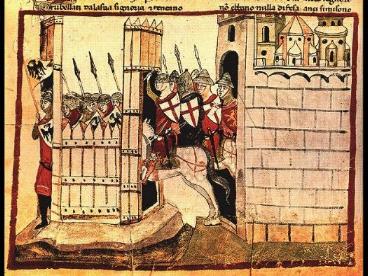
Attack by the people of Parma on Frederick's camp from the Illustrated Chronicle by Giovanni Villani. Image from Stupormundi.
It is the winter of 1248, and for nearly a year, Parma has been under siege by Emperor Frederick II as part of his campaigns to subjugate the Guelph communes of northern Italy. To make his victory even more symbolic, the Emperor established a new city on his encampment, about a mile from the city walls, aptly named "Vittoria", which he intended to replace Parma with once it was destroyed. Defending Parma is the Guelph army, composed of Parmesans and allied Guelph contingents, while Frederick commands a vast force that includes German knights, Saracen archers, troops from the Kingdom of Sicily, and soldiers from Ghibelline communes. However, maintaining such a large army for an extended period is too costly for the Emperor's depleted finances, leading him to dismiss many allies during the winter, thus losing part of his numerical superiority.
In this context, the Guelphs await the opportunity for a decisive sortie. This opportunity comes when Frederick, bored by the slow pace of the siege, departs with a substantial escort of knights for a hunting expedition far from Vittoria. Seizing the moment, the Parmesans send out a cavalry force as a diversion, drawing away other imperial knights. Suddenly, at the sound of bells, the army of Parma emerges from the city walls and attacks the Ghibelline camp. The imperials, unprepared, rush into the open field but are overwhelmed by the enemy’s superior numbers. The Parmesans then assault the encampment with flaming arrows, and soon panic spreads through the Ghibelline ranks, which falter as the Guelphs break through the weak defenses around the camp and begin looting. For Frederick, it is a disaster and a humiliation. Alongside a thousand pro-imperial soldiers killed and just as many taken prisoner, the Parmesans capture an enormous amount of booty, including weapons, animals, money, and even Frederick's personal belongings, including the imperial chancellery. While the Guelph victory is not decisive, it contributes to the overall failure of Frederick's project to dominate northern Italy. For Parma, it marks the end of the siege and an averted danger.
Paolo Grillo, Federico II. La guerra, le città e l’Impero, Mondadori, 2023.
2026-01-22
Salvatore Ciccarello