


The Sorrows of the Last Habsburg
Charles II and the problems of the Habsburg blood purity
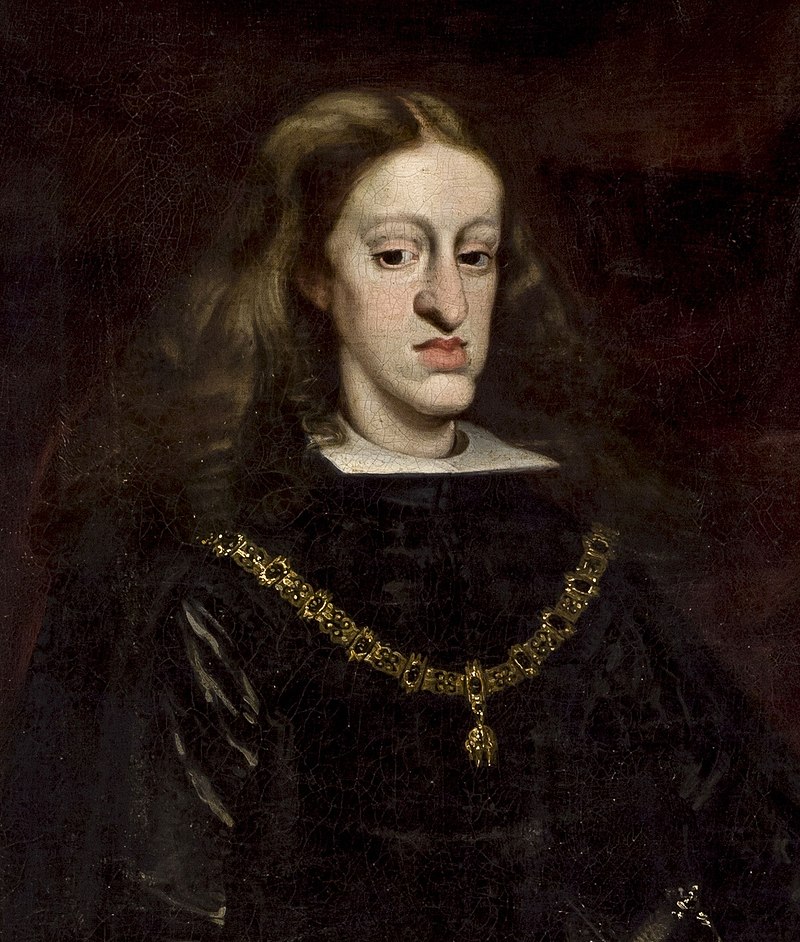
Portrait of Charles II of Habsburg - Wikicommons
Charles II of Spain (1661–1700) was the last representative of the Habsburg dynasty (Spanish branch), which had transformed the Spanish Empire into one of the most powerful of the modern era. The founder of the dynasty, Charles I (or Charles V as Holy Roman Emperor), declared that "the sun never sets" on the Spanish realm due to its expanse and economic and military strength. In addition to ruling Spain, the Habsburgs, through a series of dynastic inheritances, also controlled the Holy Roman Empire (HRE), dominating half of Europe (including Austria) and a great part of the New World.
To maintain their power & prevent it from being divided among rival dynasties, the Habsburgs pursued a long-standing policy of strategic marriages, often among close relatives. The inbreeding led to severe genetic consequences. For instance, Philip II married his cousin, contributing to a lineage plagued by hereditary disorders.
In 1661, Charles II of Spain was born, the genetic outcome of generations of inbreeding. He was the son of Philip IV of Spain and his niece, Mariana of Austria. From an early age, he exhibited physical & cognitive impairments, hallmarks of the genetic degeneration caused by consanguinity. A French ambassador at the Spanish court described Charles II in a letter to Louis XIV:
"The prince appears extremely weak. He has a herpetic rash on his cheeks. His head is entirely covered in scabs. For 2-3 weeks, a fistula has formed under his right ear."
Due to fragile health, young Charles spoke late & spent much of his life confined to bed, making him ill-suited for governance. Though he experienced occasional moments of lucidity, allowing him to exercise some control over his kingdom, his reign was largely marked by incapacity. He himself acknowledged his condition, stating:
"Many people tell me I am bewitched, and I believe it for these are the things I feel and suffer."
Plagued by constant migraines & excruciating pain, Charles II endured a life of unrelenting suffering. His only relief came with his death, which finally freed him from his afflictions. As he was sterile & left no heirs, his passing marked the end of the Spanish Habsburg dynasty.
John H. Elliott, La Spagna imperiale. 1469-1716, Il Mulino, 2006
Marco Locatelli, a graduate in Historical Sciences at Unimi, and specializing in Norse History.
2025-11-10
Salvatore Ciccarello