


Cut to the chase
The ancient carnival origin of this proverb
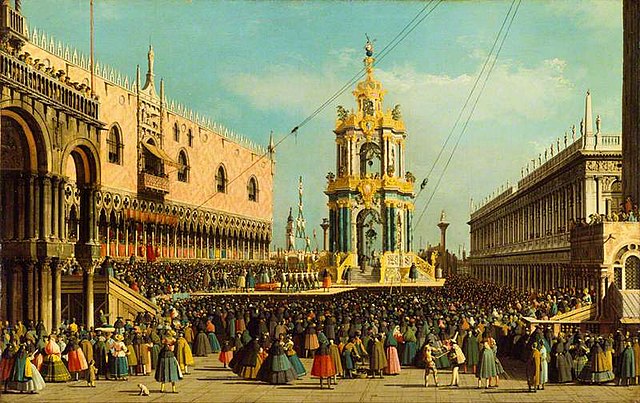
Work by Canaletto depicting the celebrations of Fat Thursday in Venice - image taken from Wikicommons
The Venice Carnival is undoubtedly one of the most famous and well-known in the world today. In the collective imagination, the masks of the lagoon city are easily recognizable. However, few people know that the Venetian Carnival is also the origin of the proverb "tagliare la testa al toro" — which translates to "cutting off the bull’s head."
The story dates back to the 12th century, a particularly complex period for Venice. The King of Hungary had seized Zara and other Dalmatian cities, while Emperor Frederick Barbarossa had begun his campaign in the Italian peninsula.
Ulrico, the Patriarch of Aquileia, sought to take advantage of Venice’s vulnerable position to conquer the city of Grado—a rival diocese since 568 and, more importantly, the spiritual center of Venice. To achieve this, Ulrico was supported by some of the most powerful feudal lords of Friuli. However, despite their efforts, Doge Vitale Michiel II swiftly recaptured Grado. Ulrico was taken prisoner along with his twelve canons and brought to Venice. The feudal lords of Friuli were punished with the destruction of their castles, while Ulrico was eventually granted freedom after a period of imprisonment. His release came with one condition: he had to pay an annual tribute to the Venetian government on Giovedì Grasso (Fat Thursday), the day on which Vitale Michiel II had secured victory. This tribute consisted of a bull, twelve pigs, and three hundred loaves of bread.
Over time, Giovedì Grasso became a carnival celebration commemorating this event. The festivity aligned perfectly with the spirit of Carnival, as it involved an elaborate parody: the bull symbolized Patriarch Ulrico himself, while the pigs represented the canons who had aided him. These animals were led to Piazza San Marco, where a mock trial took place in the presence of an actual Venetian judge. The trial always ended with a death sentence for all the animals, carried out with a single sword stroke—hence the origin of the proverb "cutting off the bull’s head."
This tradition still exists today, but instead of using a live animal, a papier-mâché bull is used in the ceremony.
Bertellli S., Il Carnevale di Venezia nel Settecento, Jouvence, Rome, 2002.
Burke P., Scene di vita quotidiana nell’Italia moderna, Laterza, Bari, 1988
2025-11-02
Salvatore Ciccarello