

Massacre and Penance
Theodosius, Ambrose and the first excommunication against a Christian ruler
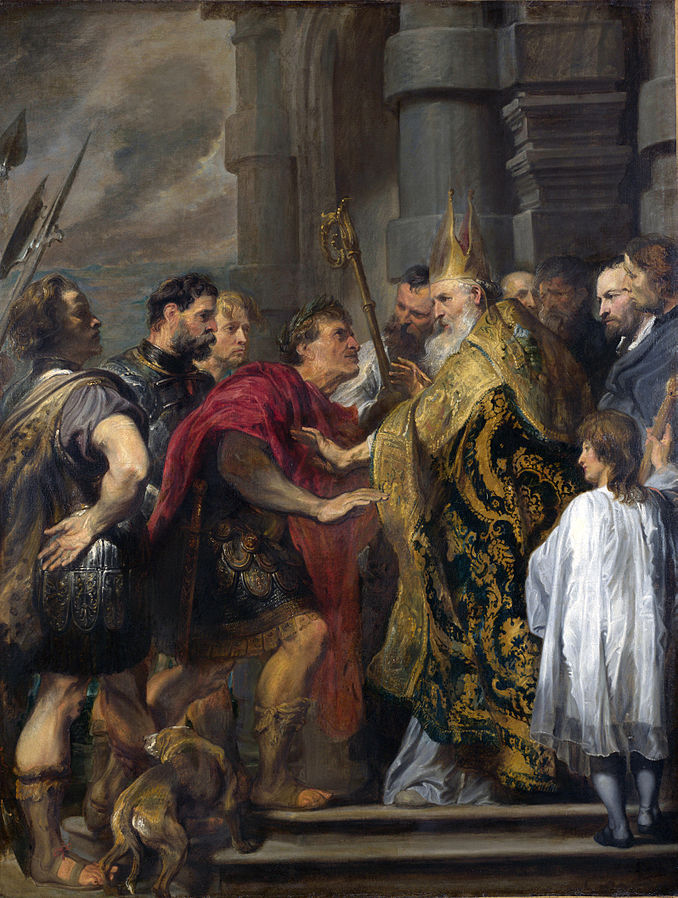
"Saint Ambrose prevents Theodosius from entering the cathedral of Milan". Painting by the Flemish painter Antoon Van Dyck (1599-1641) Image from Commons.wikimedia.org
In 390 AD, in the city of Thessalonica, the magister militum Butheric arrested a famous charioteer, accused of attempting to seduce a young boy, and ordered the closure of the city’s hippodrome. The population, angered by the absence of the games and the arrest of their favorite charioteer, demanded Butheric release him. When he refused, the citizens revolted against the Roman garrison, lynching and hanging the military governor himself. It is possible that the rioters' anger also had ethnic motivations, as many Roman soldiers at the time were of Germanic origin; Butheric himself was likely a Goth. The news of the uprising reached Emperor Theodosius, who was at the imperial court in Milan at the time. The exact order given by the emperor is unclear, but during the suppression, soldiers massacred thousands of people in the hippodrome, including the elderly, women, and children. Despite a belated attempt by Theodosius to withdraw the order, he was held responsible for the massacre. The event reached Ambrose, Bishop of Milan, who sent a letter to the emperor stating that, after the atrocities he had caused, it would be impossible for him to celebrate the sacrament of the Eucharist in Theodosius's presence. He urged the emperor to do penance. In effect, Ambrose had excommunicated Theodosius: it was the first time this had happened to a ruler, but it would not be the last. By doing so, Ambrose also offered Theodosius the opportunity to restore his image, which had been tarnished by the massacre and his inability to control his troops. The chronicler Theodoret recounts that Theodosius, stripped of his imperial garments and dressed in a simple tunic of a penitent (public penances were quite common at the time), waited daily on his knees outside the cathedral of Milan until Christmas, when Ambrose finally readmitted him to communion. The bishop greatly appreciated the emperor's gesture, praising him for listening not to those who flattered him but to those who reproached him. Following this event, Theodosius further hardened his religious policy against paganism, perhaps influenced by Ambrose himself.
Book: Gianluca Potestà, Giovanni Vian, "Storia del Cristianesimo", Il Mulino, 2014
Book: Leonardo Tondelli, " Catalogo dei santi ribelli ", Utet, 2022
Site: " Instoria.it ", Teodosio, santo o assassino? Dall'editto alla strage di Tessalonica, by Serena Scicolone, 2019
Site: "Trentagiorni.it", Ambrogio e Teodosio: dalla commozione alla penitenza al rispetto delle pubbliche autorità, by Lorenzo Cappelletti, 2010
2025-10-29
Salvatore Ciccarello