


All against all in the land of golden wheat
Political and military chaos in Ukraine between 1917 and 1920
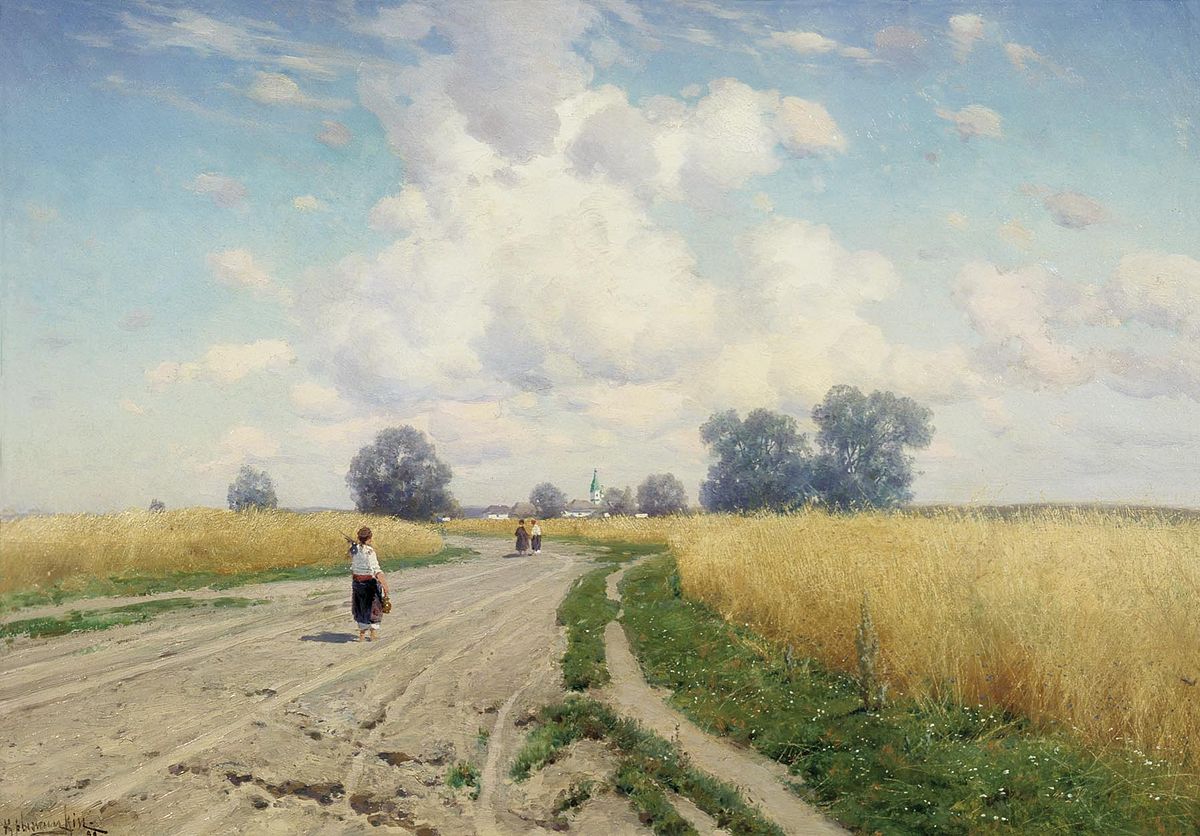
"The Road", painting by Konstantin Kryzhitski (1858-1911) Russian painter of Ukrainian origin. The desire to take possession of the grain of Ukraine (like the one in the painting) to supply their armies was one of the things that united all the governments that succeeded one another in Kyiv between 1917 and 1920. Image from commons.wikimedia.org
With the February Revolution of 1917, power in Ukraine was taken by the Rada, the local parliament. Its primary goal was the creation of an autonomous Ukraine, something the Russian provisional government opposed. Nonetheless, Petrograd recognized the authority of the Kiev Rada, granting it some powers. However, after the October Revolution, the Bolsheviks intervened to overthrow the "bourgeois government" of the Rada, though not before it declared the establishment of the Ukrainian People's Republic in January 1918.
This was followed by a period of extreme political instability, marked by coups, army movements, and numerous actors involved. Germany, still fighting on the Russian front, played a significant role, obtaining the creation of an independent, pro-German Ukraine in March 1918 by driving out the Bolsheviks. Initially, the Germans restored the Rada government but later supported the rise to power of General Skoropadskyi, who proclaimed himself "ataman" and was considered more likely to supply grain to the German army, as agreed. Skoropadskyi's regime became increasingly unpopular, paving the way for Ukrainian nationalists who advocated for a truly independent Ukraine.
In eastern Ukraine, the nationalists, led by Symon Petliura, were primarily anti-Russian, while in western Ukraine, their main adversaries were the Poles. Petliura's strategy prevailed, and he agreed to cede western territories to Poland in exchange for support against the Bolsheviks. Between 1919 and 1920, Kiev was also occupied by the White Army, traditional opponents of any autonomy movements. The Red Army occupied the country and was driven out three times before eventually achieving victory, in part thanks to an alliance with the anarchists. Ukrainian peasants, exhausted by the confiscation policies of the various governments and armies, joined the ranks of the anarchist Nestor Makhno in large numbers. In 1920, Makhno allied with the Red Army to fight against the Whites and then against Petliura, only to be betrayed and isolated by the communists.
In just four years, no fewer than ten different governments had taken power in Kiev.
Book: L'Ucraina in 100 dati: dalla Rus di Kyiv ai nostri giorni , Giulia Lami, Della Porta Publishers, 2022
2025-11-12
Salvatore Ciccarello