


ITALY
Etymology of a term and a nation
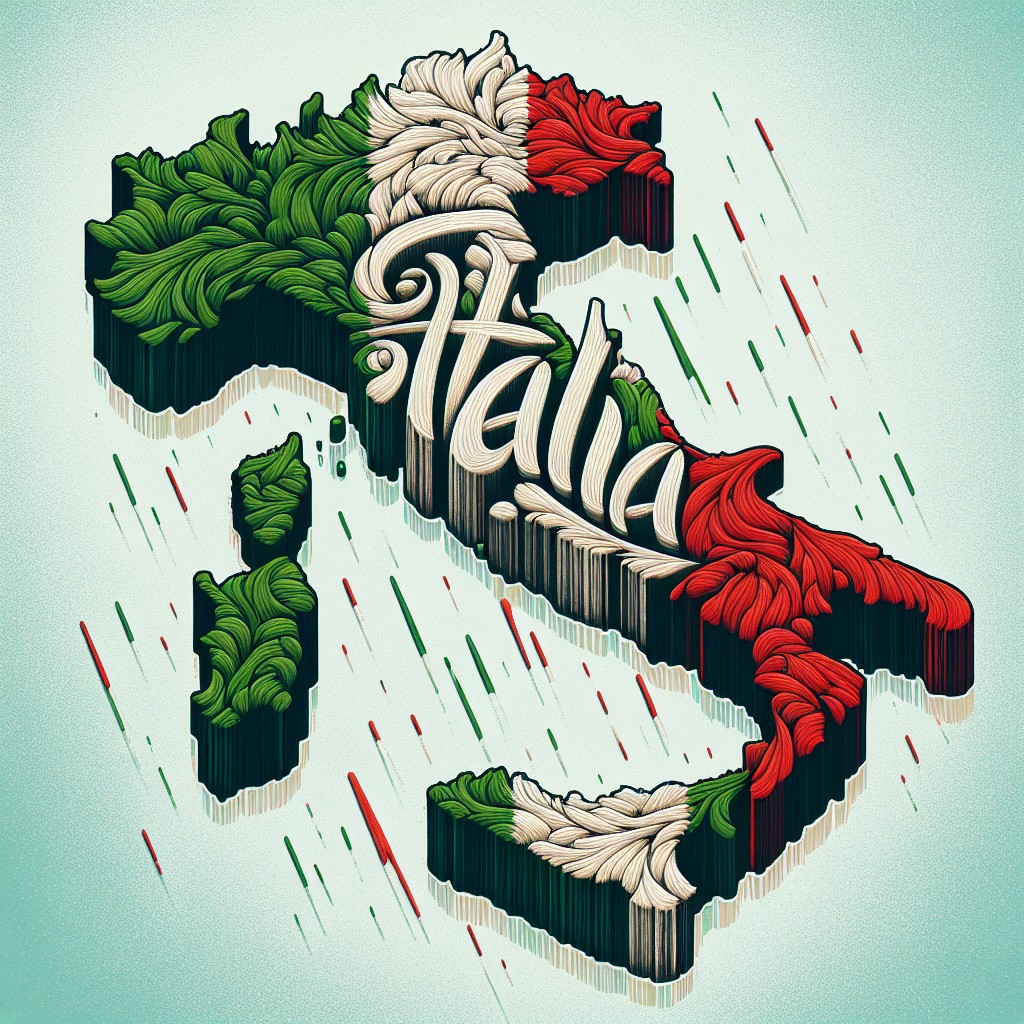
Allegorical image of the name Italy in tricolor - Image generated with AI
The term "Italy" has long been a subject of debate among both historians & linguists. We use the name to refer to our country, the peninsula, the "boot with a pointed heel," yet we frequently overlook its origins. It is believed that the name derives from the ancient Greek word Italòi ("Italians"), which the Greeks used to identify the populations inhabiting the southernmost part of the peninsula. Following their colonization, the Greeks themselves began to refer to their own settlers in the region as "Italiots," meaning "inhabitants of Italy."
Linked to this theory is another suggesting that the name "Italy" originates from the Ancient Greek Aithàleia (Αιθαλεια), meaning "burning" or "blazing," a reference to the volcanic activity of the region (Mount Etna & Vesuvius), where the Itali resided. But what was the peninsula called before the Greeks arrived? The historian Antiochus of Syracuse provides insight: "The region that is now called Italy was once inhabited by the Oenotrians; at a certain time, their king was Italus, and from then on, they changed their name to Itali [...], and Itali were those who were formerly Oenotrians."
Another ancient author, Varro, proposed that "Italy" derived from vitulus (calf), due to the abundance of these animals in the region. With the rise of Rome, the term was Latinized into Itulus, which later evolved into "Italia," extending its reference beyond the southern region to encompass the north as Roman conquests progressed.
Originally of Greek origin and later adopted by the Romans, the term "Italy" initially referred only to the southern part of today's country. Over time, it came to represent the entire peninsula, symbolizing a unified territory long before the official political unification in 1861. Evidence of this can be found in the medieval period, when Arduino of Ivrea held the title of "King of Italy" or "King of the Italics" from 1002 to 1015 as a ruler under the Holy Roman Empire.
Being Italic/Italian and belonging to the geographical region of Italy is not about residing in a specific place. It encompasses a people with a cultural identity unique in the world — one shaped by centuries of struggles and evolution.
Andrea Giardina, Storia Mondiale dell'Italia, Laterza, 2019
2025-10-30
Salvatore Ciccarello