


A headdress... to be removed at the cinema
The Tarbusc of the Ascari
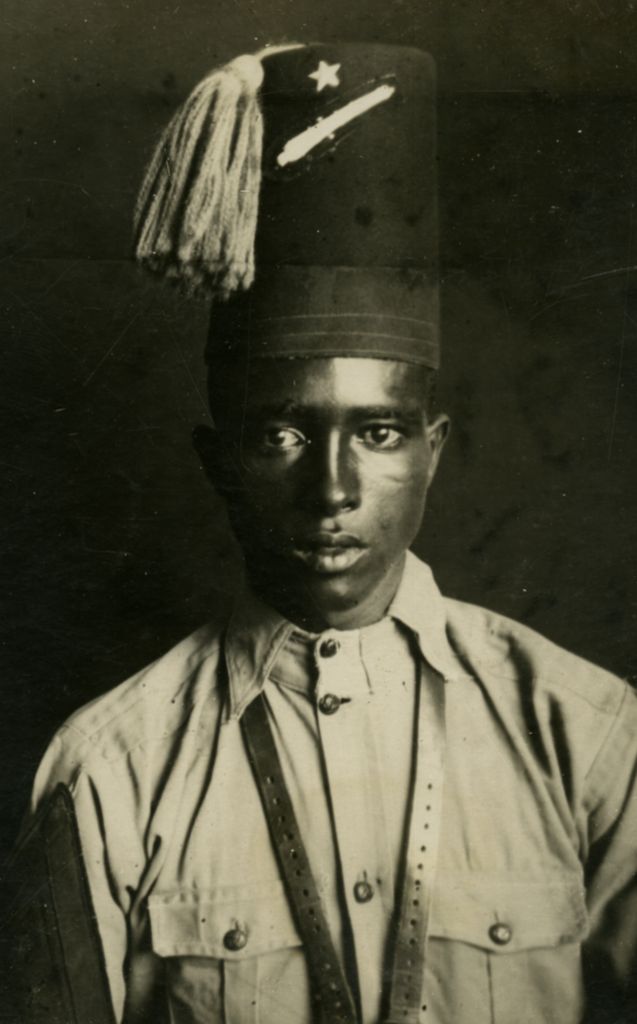
A Somali artillery ascari wears the Muntaz rank and the selected pointer badge on his tarbusc, 1929. (MITAG Photographic Archive - Italian Historical War Museum)
The tarbush was the iconic, truncated-cone-shaped hat in dark red felt worn by East African troops in the Italian Royal Colonial Corps, the famous askaris. It was inherited from the Egyptian garrison of Massawa, inspired by the Ottoman fez, and topped with a distinctive bow. Initially just a dozen centimetres high, in the early 1900s its height nearly doubled to 20 centimetres. This change was not practical but instead a clever move to elevate colonial soldiers to the social level of Egypt and Sudan's wealthy classes. The idea was a resounding success. The tarbush became a true fetish for the askaris, especially Eritreans, who refused to part with it. Their pride was so strong that wounded soldiers would bandage their heads around the hat, or even replace it over the bandages. In 1915, commanders reportedly had to order troops to remove the cumbersome headgear during movie screenings so others in the back rows could see.
General discontent erupted when, starting in 1936, the army decided to replace this showy hat with a more practical but anonymous khaki canvas cap. Despite this, Italian companies continued production, such as Cappellificio Cambiaghi of Monza, until 1939. The tarbusc was meticulously made. To prevent uncomfortable contact between the felt and the skin, a protective band called an alluda was added inside. Sometimes the hat was fully lined. To keep it securely on the head, the tarbusc did not use a chin strap. The classic chin strap was only for mounted units and certain police troops, such as the zaptiè and the P.A.I. Instead, a leather strap passed behind the neck. The look was completed by a bow. The military provided a simple wool version, but some soldiers preferred a bulkier, more luxurious silk version, bought on the market at their own expense.
Davide Zendri L'Africa in deposito. Collezioni coloniali italiane nei musei Euregio, Verlag Militaria, Vienna, 2025.
Davide Zendri
2026-10-15
Paola Manunta